
Birthright Citizenship—The Waiting is the Hardest Part
by Ava Benach
Why U.S. Citizenship Rejects Hereditary Titles
On the application to become a citizen of the United States, among questions about crimes, military service, deportations, and lies is a curious question that stands out for its obscurity. Question 30a. on page 10 is “Do you now have , or did you ever have, a hereditary title or an order of nobility in any foreign country” If the answer to 30a is “yes,” you must answer question 30b which is “are you willing to give up any inherited titles or orders of nobility that you have in a foreign country at your naturalization ceremony?”
Immigration & Nationality Act §337(b) requires citizenship applicants with hereditary titles to make “an express renunciation of such title or order of nobility.”
The Constitution’s Rejection of Nobility and Bloodline Privilege
The United States Constitution, itself, firmly rejects the entire concept of nobility and hereditary titles. “No Title of Nobility shall be granted by the United States” reads the first clause of Article 1, Section 9, Clause 8. In Adarand Constructors, Inc. v. Peña, 515 U.S. 200, 239 (1995), Justice Scalia stated that the Nobility Clauses illustrate the Constitution’s “rejection of dispositions . . . based on blood.” It is clear that America has, in the words of Justice Brennan, an “aversion to aristocracy.”
America’s Founding Ideal: No Kings, Queens, Dukes, or Counts
Why does the U.S. have such a revulsion to hereditary titles? Because the idea that someone is elevated above someone else because of the circumstances of their birth, by the blood that runs in their veins, wholly undermines the concept of a government “of the people, by the people, and for the people.”
America was founded as a country where there were to be no kings or queens, dukes or counts, lords or ladies. Where every man (and it was limited to white property-owning men) no matter what his fathers did could rise above his station in life.
American poet Lin-Manuel Miranda asked of Alexander Hamilton; “How does a bastard, orphan, son of a whore and a Scotsman, dropped in the middle of a forgotten spot in the Caribbean by Providence, impoverished in squalor grow up to be a hero and a scholar?” And then he answers it: “Got a lot farther by working a lot harder, By being a lot smarter, by being a self-starter.”
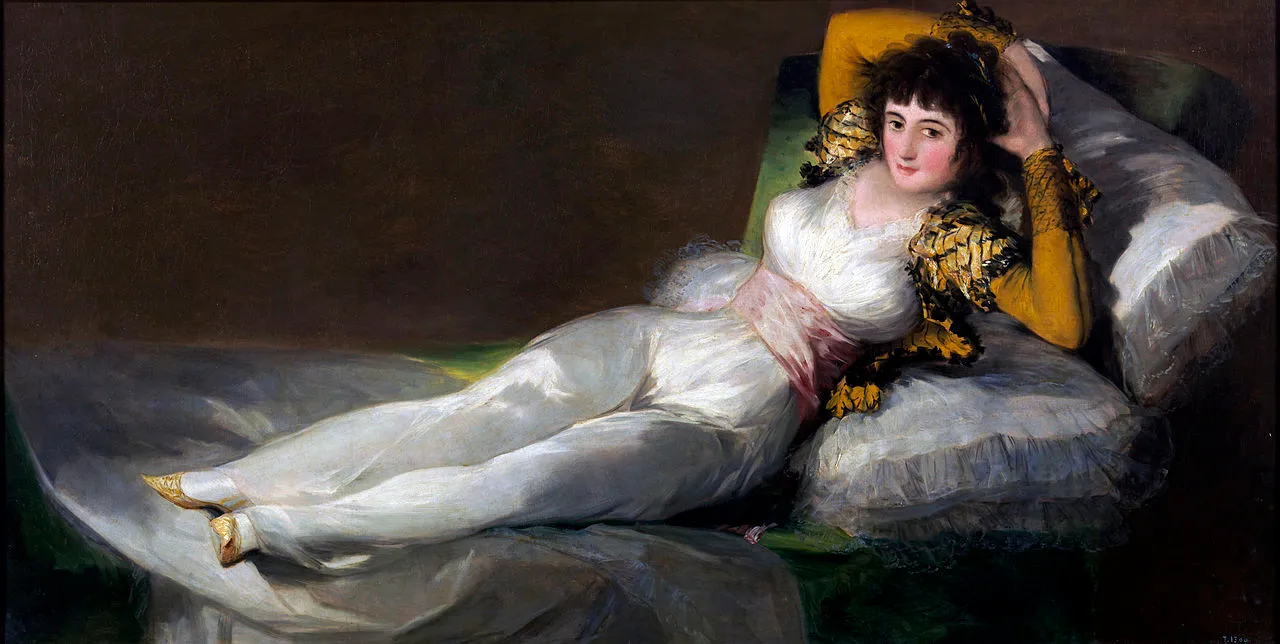
Here I must confess something. I can trace my lineage back to Castilian Kings. But somewhere on the bumpy road from Madrid to Havana to New York, I shed any title of nobility and any hereditary grace. I would never be painted by Goya, as he did the Duchess of Alba, as much as I would like to be a Duchess. A Republican Duchess, but still a Duchess.
Immigration, Anti-Monarchy, and the 14th Amendment
In the 1850s, the U.S. accepted hundreds of thousands of immigrants from Germany and Ireland after the defeat of the Revolutions of 1848. In the 1848 Revolutions, people rebelled against absolute monarchy and establishment of democratic rule and republican governments.
When the revolutions were crushed many of the revolutionaries left their homelands for exile in the United States. They brought their contempt for autocracy and their anti-slavery attitudes to the U.S. and volunteered in droves in support of the Union in the American Civil War.
The American Civil War, itself, can be seen as the triumph of the idea that one is not simply defined by the circumstances of their birth. The idea was crystallized in the Fourteenth Amendment making all those born in the U.S. citizens.
Why Rejecting Birthright Citizenship Is Anti-American
The rejection of birthright citizenship is a profoundly Anti-American concept. At its core, it believes that there is something sacred about blood- that the blood in our bodies pre-determines who we are. That has never been the American idea. Yes, the American idea has been perverted into slavery, Jim Crow, Japanese internment and other reflections of the idea that the circumstances of someone’s birth are determinative to their worth as a person.
What Makes a Person American
What makes a person American is not being the descendant of a pilgrim from the Mayflower or having fought at Saratoga or Gettysburg. It is belief in an idea that each person has been “endowed by their Creator with certain unalienable rights, among these are life, liberty and the pursuit of happiness.”