
Federal Court Strikes Down Trump Rule on Visa Time Limits for Students, Researchers and Journalists
Yesterday, a federal judge in Massachusetts struck down a Department of Homeland Security (DHS) rule issued by the Trump Administration that had sought to impose a fixed time period on visa for journalists, professors, and students.
The rule, which had already been stayed by a preliminary injunction issued by the same judge in September, has now been struck down nationwide. Judge Saylor, a George W. Bush appointee, issued the ruling. DHS is almost certain to appeal.
How Duration of Status Works for F-1, J-1 and I Visa Holders
Three types of visas were slated to be affected by the rule:
- F-1 Visas, which are issued to foreign students coming to the United States to study;
- J-1 Visas, which are issued to researchers and professors on exchange programs; and
- I Visas, which are issued to foreign journalists.
As we’ve explained in a prior blog post, the current system allows F-1 and J-1 visa holders to stay in the U.S. for the duration of their academic program. I visas allow members of the foreign press to stay for the duration of their employment. This is known as “duration of status,” or D/S. All these visa holders are also given a 60-day grace period at the end of the term. The end date of an academic stay has long been dictated by an I-20 form issued by the school listing the end date of the program.
A stay could be extended without leaving the country or having to file any additional paperwork with the U.S. Citizenship and Immigration Services (USCIS). The school could simply issue a new I-20 form with a new program end date. For journalists, because the end date is tied to their employment, each foreign media outlet can control the length of their employees’ visas.
What the Fixed-Time Visa Rule Would Have Changed
The blocked rule would have totally changed this system by instead instituting a fixed time period for these visas: four years for F and J visas and 240 days for journalists with I Visas.
Those seeking to extend their stay would have to file an extension-of-stay request, and a DHS denial of such a request would be “entirely discretionary and unappealable,” according to the Court’s September opinion in support of the preliminary injunction.
Why the Federal Court Struck Down the Duration of Status Rule
Judge Saylor found that the rule violated the law governing federal regulations, because DHS failed to appropriately weigh the costs and benefits of the rule, the rule did not address the purported rationale behind it, DHS did not consider less restrictive alternatives, and DHS neglected to address significant concerns reflected in the more than 22,000 public comments submitted about the rule.
The court also held that the rule exceeded the Administration’s statutory authority under the Immigration and Naturalization Act, which is limited to setting the “times” and “conditions” of non-immigrant visas.
How the Rule Could Have Affected Students, Researchers and Journalists
The court’s specific substantive critiques of the rule included finding that:
- By failing to specify the criteria necessary to obtain a visa extension, the rule opens up the possibility of viewpoint discrimination against academics whose research is disfavored by the current Administration and reporters whose coverage is critical of the U.S. government;
- By prohibiting students from obtaining a second degree at the same or a lower level, the rule effectively prohibits joint degrees and keep students from changing their academic objectives; and
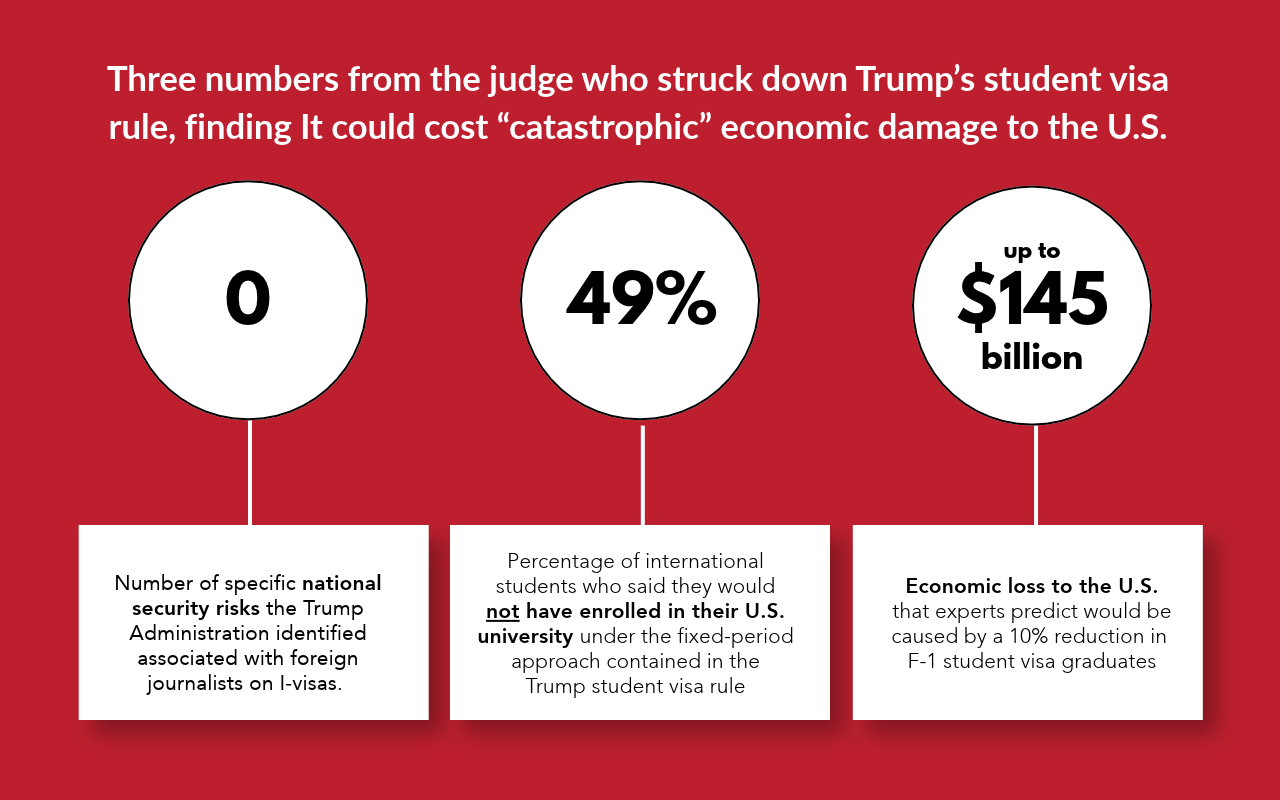
- The rule could cause “catastrophic” economic damage to the United States by driving away the world’s most talented students and researchers from American universities, costing the U.S. economy tens of billions of dollars annually.
Why the Court Rejected DHS’s National Security Justification
In addition, the court found that the government’s argument that the rule is needed for national security reasons “borders on the absurd” and that its examples of a handful of troubling incidents involving foreign students would not have been prevented by the rule.
In addition, DHS already has an online government system in place that tracks visa holders, the Student and Exchange Visitor Information System (SEVIS), and the government failed to explain why this system could not be enhanced to address its fraud and security concerns instead of overhauling the entire system with its proposed rule.
The court observed that the government did not even provide a rationale for restricting the duration of an I Visa to a mere 240 days, noting “DHS did not identify a single specific national security risk associated with foreign journalists on I-visas.”
A newspaper journalists labor union, one of the plaintiffs in the case, argued that the 240-day time period would be insufficient for a journalist to get familiar with a new country and develop sources there.
While the judge declined to rule on constitutional claims, the restrictions on journalists also raise obvious First Amendment issues, whose protections extend to immigrants.
What the Ruling Means for F-1, J-1 and I Visa Holders
This decision will come as good news for the nearly 2 million people currently holding F-1 and J-1 visas, particularly those in Ph.D. programs, which nearly always take more than four years, as well as the tens of thousands of foreign journalists currently working in the United States.