
BPR Win: Fourth Circuit Strikes Down Trump’s Mandatory Immigration Detention Policy
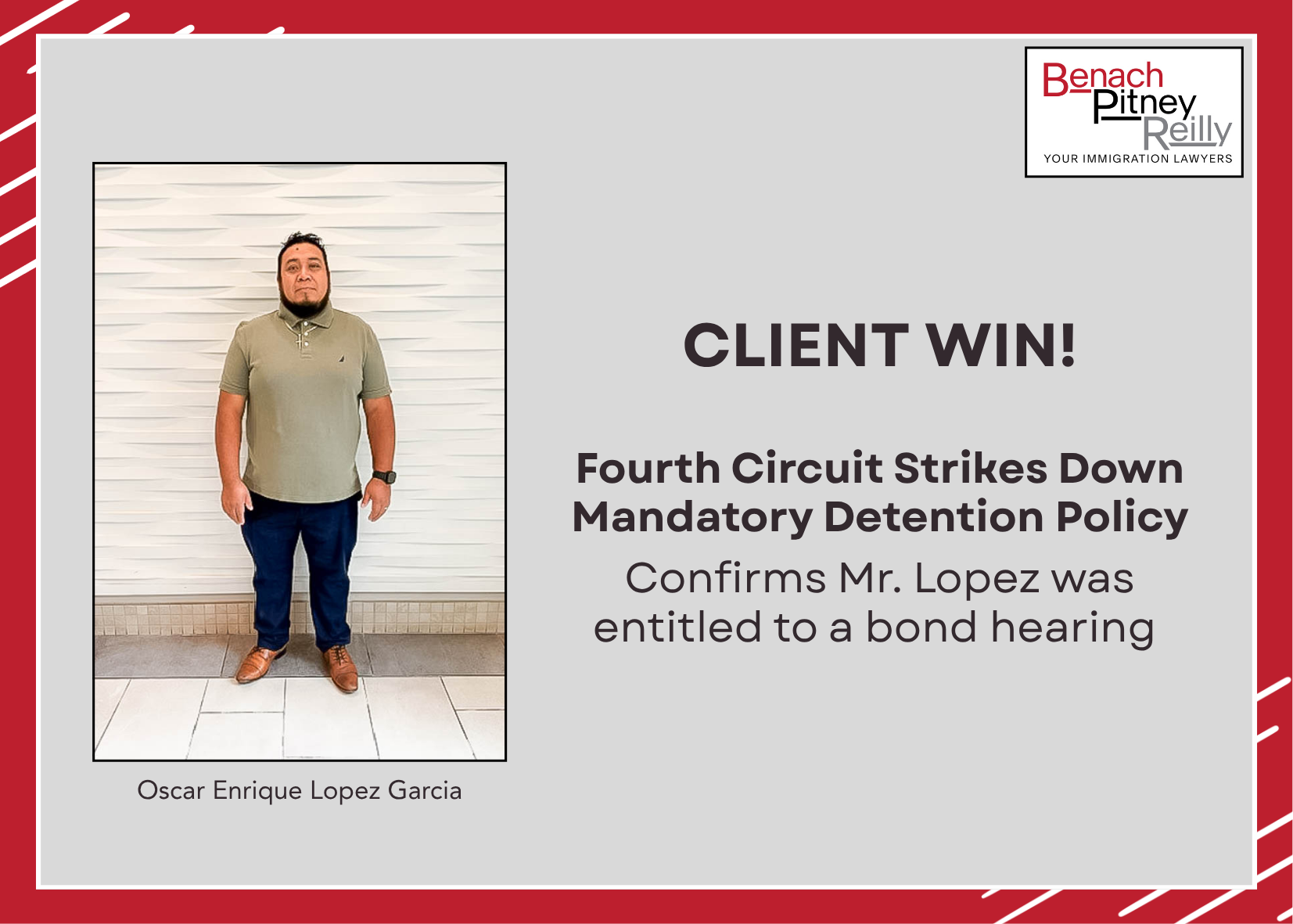
Today, we were thrilled to learn that the U.S. Court of Appeals for the Fourth Circuit ruled in favor of Benach Pitney Reilly client Oscar Enrique Lopez Garcia, finding that Mr. Lopez and his co-petitioner Juan Jose Rivera were entitled to bond hearings. Originally from Guatemala, Mr. Lopez came to the United States as a child and has lived here for 30 years.
He is a married father of two with no criminal record. Last October, ICE officers apprehended Mr. Lopez while he was on his way to work. We filed a habeas petition on his behalf, and the district court judge ruled that Mr. Lopez must be provided with a bond hearing, which resulted in Mr. Lopez’s release and return home. The Trump Administration government, however, appealed his case to the Fourth Circuit.
How BPR Challenged the Mandatory Immigration Detention Policy
Along with co-counsel, we argued to the appellate court in May that this radical change denying bond hearings to immigrants like Mr. Garcia and Mr. Rivera directly conflicts with the plain text of the law and its interpretation by five consecutive presidential administrations, including the first Trump Administration. The Fourth Circuit agreed.
Why the Fourth Circuit Ruled That Bond Hearings Are Required
Writing for the panel, Judge Nicole G. Berner found that the law requires a bond hearings for immigrants like Mr. Lopez and Mr. Rivera. Also, taking note of the “universal, longstanding interpretation of the detention statutes at issue” the opinion points out the absurdity of the government’s position that “Congress mandated the detention of millions of people and upended the longstanding distinction, grounded in the Due Process Clause of the Constitution, between those arriving at our borders and those already present in our country. Yet no one took notice for three decades.”
The Due Process and Historical Concerns Behind Mandatory Detention
Importantly, the court’s opinion also raised the “moral implications” of a mandatory detention policy that would affect an estimated six million people. Judge Berner’s words deserve quoting in full:
Mass detention of marginalized individuals without due process harkens back to some of the darkest moments in our country’s history. In 1892, Congress enacted the Geary Act, which called for the mandatory detention of and “hard labor” for Chinese persons who were “adjudged to be not lawfully entitled to be or remain in the United States[.]” Geary Act, 27 Stat. 25, § 4. Thousands of Chinese persons were unconstitutionally detained under this Act in violation of their due process rights. See Wong Wing v. United States, 163 U.S. 228, 232–35 (1896). Fifty years later, with racial animus masquerading as national interest, the government ordered the mass detention of all individuals of Japanese descent present in the United States during World War II. Nearly 120,000 people were sent to internment camps within our borders. United States v. Hohri, 482 U.S. 64, 66 (1987).
The stain of these detentions on our nation—and the judiciary’s abdication of its obligation to protect basic freedoms—continues to haunt us. See, e.g., Trump v. Hawaii, 585 U.S. 667, 710 (2018) (stating that the Supreme Court decision affirming executive policies on Japanese internment “was gravely wrong the day it was decided, has been overruled in the court of history, and—to be clear—‘has no place in law under the Constitution’” (internal quotation marks omitted)). Those shameful and abhorrent past detentions were limited in scope in comparison to the mandatory detention that the Government urges us today to find that Congress established thirty years ago in an ambiguously worded statutory provision. We decline to do so.
A Growing Circuit Split Could Send Mandatory Immigration Detention to the Supreme Court
The Fourth Circuit joined eight other circuit courts in striking down the mandatory detention policy. The Fifth and Eighth Circuits, however, ruled the other way and upheld the policy. Because of this split between the circuit courts, we expect the issue will ultimately be decided by the U.S. Supreme Court.
If you or a loved one has been affected by the mandatory detention policy and need legal assistance, please contact us.