
The New Public Charge Rule: What You Need to Know
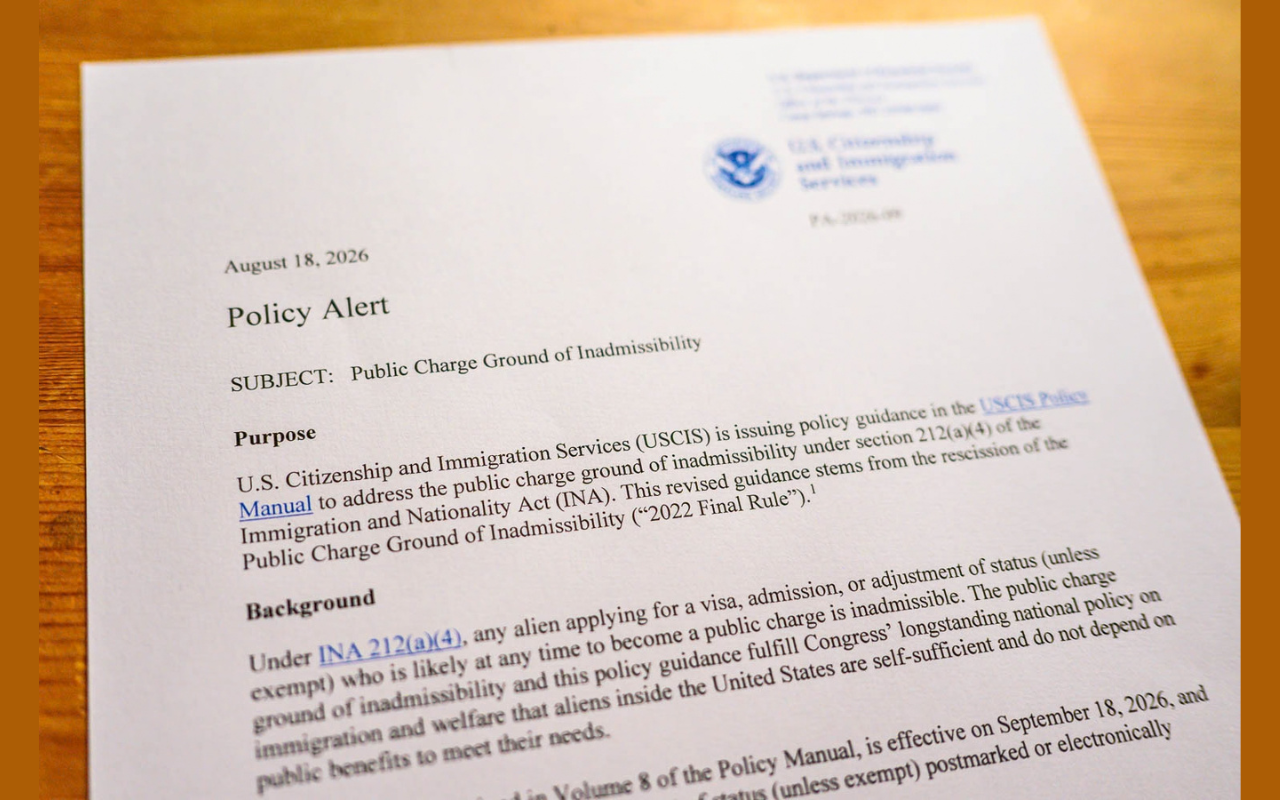
Last week, the Trump Administration’s new public charge guidance went into effect. What is a “public charge,” you might wonder? It’s a concept that dates back to the late 1800s when our government’s anti-immigrant sentiment rivaled that of today. To ensure that only people with financial means were permitted to immigrate to America, Congress included a provision in the Immigration Act of 1882 denying entry to “persons likely to become a public charge”—in other words, those likely to rely on financial assistance from the government.
How the Public Charge Rule Has Changed Over Time
History of the Public Charge Exclusion
The public charge provision has remained in our immigration statutes ever since 1882. If someone is deemed likely to become a public charge, they can be denied a visa, admission to the U.S., a green card, or even deported.
For more than 100 years, however, the term “public charge” lacked a specific definition and determinations were made on a case-by-case basis. In 1999, the Clinton Administration issued guidance to clarify the term, limiting the definition of public charge to those “primarily dependent on the government for subsistence,” because of the receipt of only two types of benefits:
(1) cash benefits (such as those from the Temporary Assistance for Needy Families program sometimes known as “welfare”); or
(2) government-sponsored long-term institutionalization.
Benefitting from other means-tested government programs were not grounds for a public charge exclusion under the 1999 guidance.
How the Trump Administrations Expanded the Public Charge Rule
In 2019, the first Trump Administration attempted to vastly expand the definition of public charge. It issued a rule expanding what should be considered in a public charge determination to include whether a person had received almost any means-tested government benefit, such as most forms of Medicaid, Supplemental Nutrition Assistance Program (SNAP) benefits (i.e., food stamps), and housing vouchers.
To give some perspective of the scale of this change, fewer than 2.1 million people receive TANF benefits each year, compared with more than 73 million who are enrolled in Medicaid or the Children’s Health Insurance Program (CHIP). The rule was challenged in court, however, and ultimately rescinded by the Biden Administration, which restored the Clinton-era definition of a “public charge.”
Predictably, the second Trump Administration rescinded the Biden rule last year and issued guidance last month once again expanding the definition to include nearly all means-tested government programs. The new guidance went into effect last Friday, September 18, 2026.
Legal Challenges to the New Public Charge Rule
As with the previous Trump public charge rule, the new guidance has been challenged in court. Earlier this month, a coalition of 22 states filed suit in federal district court, led by New York Attorney General Letitcia James. A group of cities—including New York City, Chicago, and San Francisco—filed a second suit.
To date, however, no injunction has been issued and the guidance is currently in effect. We will keep you posted as the courts consider these claims.
Who is Affected by the New Public Charge Rule?
A public charge determination is made when an immigrant applies for admission to the U.S., a visa, or a green card (also known as lawful permanent residency (LPR)), including if they have left the U.S. to obtain a green card through their consulate or embassy.
However, Congress has exempted immigrants applying on humanitarian grounds from the public charge rules, including asylum seekers, refugees, those with temporary protected status (TPS), and victims of sex-trafficking (T Visa holders). The full list of exempt categories can be found here.
What USCIS Considers in a Public Charge Determination
Under the new guidance, in determining whether someone is likely to become a public charge, USCIS officers can consider the receipt by the applicant or others in their household of any means-tested government benefit program. These include:
- cash assistance (such as TANF);
- housing assistance (such as Section 8 vouchers);
- health care assistance (such as most types of Medicaid);
- food stamps (i.e., SNAP benefits);
- financial aid for college, or
- any other similar benefit.
How Benefits Received by Household Members May Affect an Applicant
The consideration of household benefits is a significant aspect of the new guidance. While the Trump Administration has stripped most immigrants lacking green cards of eligibility for government benefit programs, many immigrants live in mixed-status households.
For example, an immigrant seeking to adjust their status could have it held against them if their U.S. citizen children have received government benefits to which they are legally entitled, such as CHIP coverage.
The USCIS officer making the determination will also consider a person’s age; health; family status; assets, resources, and financial status; and education and skills. Each decision is supposed to be made on a case-by-case basis considering the totality of the circumstances.
Receiving Public Benefits Does Not Automatically Make Someone a Public Charge
While this all seems to set up applicants for denial (and we admit that was the administration’s intention), it is not hopeless. The changes made to the USCIS practice manual caution adjudicators:
Current and/or past receipt of means-tested public benefits alone, however, is not a sufficient basis to determine that an alien is likely at any time to become a public charge. Additionally, past applications to receive means-tested public benefits and past approvals or certifications to receive means-tested public benefits are not, alone, a sufficient basis to determine that an [immigrant] is likely at any time to become a public charge.
The USCIS practice manual reminds officers: “This is just one piece of information that officers consider in the totality of the circumstances and such receipt, or lack thereof, is insufficient on its own to establish that an [applicant] is or is not inadmissible.”
Important Exemptions and Limitations of the New Public Charge Rule
It is important to remember that not all immigrants are subject to the public charge rule. Again, it does not apply to those seeking green cards because they are refugees, seeking asylum or temporary protected status, a victim of sex trafficking, a petitioner under the Violence Against Women Act, and certain other specific enumerated categories.
For those subject to the rule, only receipt of non-cash benefits on or after September 18, 2026 will be considered. For benefits received prior to that date, only cash benefits or long-term institutionalization will be considered.
DHS has the ability to waive a public charge finding as a ground for inadmissibility and for certain applicants for adjustment of status.
If a public charge determination is the only impediment to an immigrant’s adjustment of status, the USCIS officer may invite them to post a public charge bond and, if the bond is posted, may grant their adjustment of status.
The complexity of the new public charge guidance underscores yet again the importance of having a skilled and experienced advocate by your side on your immigration journey.
If you have questions about the new public charge rules, the advisability of someone in your household accepting government benefits, or other immigration questions, please contact us.